ff
Discover the Life-Changing Genius of Meal Making Transformation!

Introduction
Fearless Questions
Here is a question that has mystified me for years: In a world of plenty, why do we have so much trouble feeding ourselves well?
Perhaps you want to eat well and have tried your best. If so, then you’ve probably experienced one of the barriers that makes it so challenging and troublesome, which is:
Sustainability
Most people will agree that sticking to a diet is pretty doable–for a week! Or maybe even a month. The hard part is sustaining a good eating lifestyle for many, many weeks, months and years.
Over my 35 years in the healthy meal making area, I’ve seen it countless times. After a class or coaching session, participants and clients are all excited to uplevel their food lives. But within a couple months, or even just weeks, those good intentions have all but vanished. Why? Because we haven’t found a way to make them sustainable.
This is where Meal Making Transformation comes in.
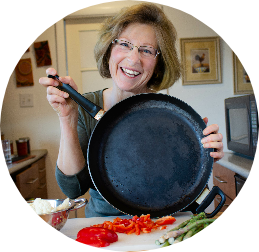
This threefold solution is all about transforming healthy meal making so it becomes manageable enough that ordinary home cooks can prepare and eat wholesome, tasty meals sustainably, for life.
Meal Making Transformation has three parts:
- Being New in Our Cooking
- Being New in Our Kitchens, and
- Being New in our Thinking.
While each of these elements plays an integral part in the Transformation solution, Being New in our Thinking is the key foundational piece because, in a nutshell, that’s how we get our head behind our actions. By shifting our thinking and values on the inside, life on the outside changes to match–very often without a lot of struggle, stress or sacrifice.
Insightful Stories
In this short booklet I share the story of my “food evolution:”
- How did I transition from being semi-clueless around healthy eating to being someone with a comfortable grasp of how to eat well and how to make it happen in my life, regularly, naturally–and sustainably?
- How did I come to piece together the three elements of the Meal Making Transformation solution?
- How did I come to realize that what we think is intimately connected to our ability to make health-giving meals
Imagine a Radical Solution
No doubt you’ve noticed that our food world doesn’t make it easy to eat well. In fact, it pushes and cajoles us to do just the opposite!
Can you imagine a food world that actually supports your deepest hopes and dreams to eat well? Meal Making Transformation, as shared in this booklet, charts the path to this new food world. And then, as each of us transforms individually, a wonderful thing happens. Our efforts coalesce and create a whole new food world, a New Eating Culture.
Won’t you join me in creating this new food world?
Section 1: A Missing Link to Make Healthy Eating Easier
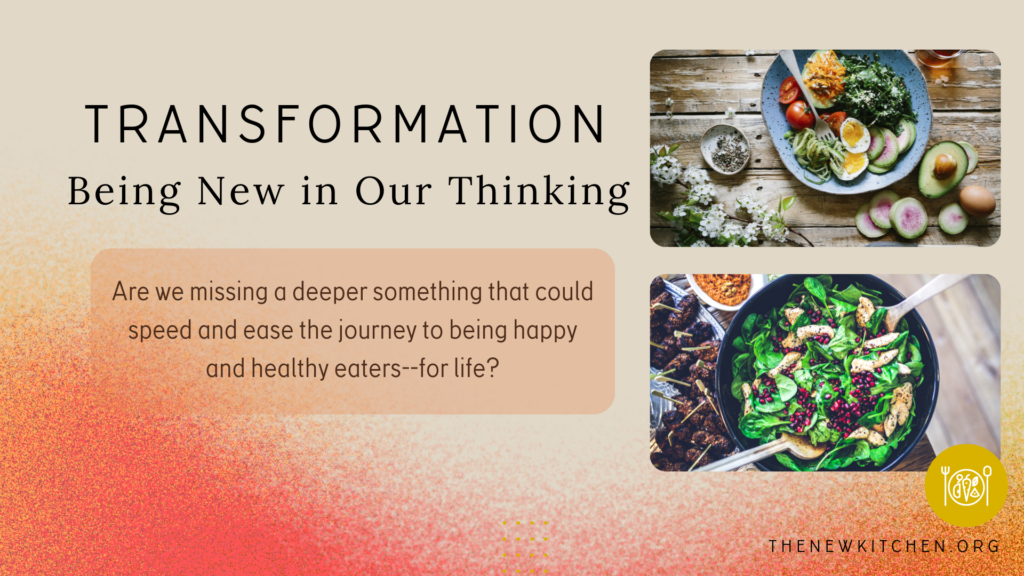
What if there was some really important nugget of information that could speed and ease the journey to become happy and healthy eaters for life? Shared in this section is that missing link, called Being New in Our Thinking.
A Churning Story
I’ve been in the healthy eating area for well over 30 years. For the longest time, I churned out lots of recipes, articles, tips, books, strategies and even a software program. That was what everyone else in the healthy eating field did–and it was what clients and customers wanted.
But about four or five years ago a realization hit me: We must be one of the most well-resourced populations in the history of mankind! We have immediate, affordable access to:
- A gazillion recipes at our Internet fingertips
- An entire network of cooking shows
- Gadgets galore
- Handy appliances from air fryers, steamers and panini makers to pizza ovens, pressure cookers and stand mixers in designer colors
- Nutritionists by the hundreds
- Thousands of cookbooks
- Hundreds and hundreds of diet and nutrition books
- Dozens of pre-prepped or pre-cooked vegetables, whole grains and meats
- A rich cornucopia of foods from around the world
- And very serviceable–even gorgeous–kitchens with counters, sinks, electricity, lighting and running water!
The Mystery
Despite all these resources, many people I have interacted with still struggle to make meals as wholesome as those made by women in traditional cultures with the most minimal of kitchens and cooking resources.
“Why is that?” I had to question. “Why aren’t our many resources helping us become lifelong healthy eaters?”
Something Deeper?
All of this led me to wonder:
Do we need something deeper than more physical things and tangible services? Do we need a transformation in the foundational way we think about food, eating, the kitchen and cooking?
A “Scientific” Experiment
Sensing that some kind of deeper transformation might be needed, I decided to see what others thought. So I undertook a “scientific” experiment, amending my newsletter sign up form to include two quick questions:
- Does the idea of Meal Making Transformation make sense to you?
- Are you interested in transforming how you make meals, especially healthy meals?
I was surprised that, without even an explanation of “Meal Making Transformation,” roughly 85-90% of respondents answered those questions in the affirmative!
I had always tiptoed around the idea of transformation because it seemed pretty unusual in the meal making area. Certainly, no one else was talking about it. But seeing the results of my “experiment,” I stopped tiptoeing and put Meal Making Transformation front and center as the mission of my non-profit, The New Kitchen.
Now it’s time to pin down exactly what Meal Making Transformation means, i.e., what does it look like? And even more importantly, why is it worth learning about it?
Sustainability
Nowadays, I can throw together a healthy, tasty meal pretty easily. But trust me, it wasn’t always like that. When I first started making the gluten-and dairy-free meals needed for my family’s health, it was highly stressful and crazily chaotic. Sure, I got decent meals on the table, but only barely!

I was able to survive for a couple of months, until we all regained our health. But I soon realized that if we didn’t want to become a sick mess again, our new way of eating needed to continue for life! Yikes!
How could I possibly keep up with daily, vegetable-rich, wholesome meal making forever?! At that time, over 30 years ago, there were no maps, trail markers, or even trails for guidance. I was left to “feel” my way to kitchen sanity all on my own. Gradually and thankfully, however, I did discover and piece together a way that healthy everyday meal making could be a reasonably doable part of our hectic modern lives.
At the time, I didn’t think of the various pieces I discovered as part of an identifiable whole called Meal Making Transformation. That understanding only came later, in hindsight. But what was very clear to me is that the pieces worked!
So Why Bother?
The strategies, tools and thinking that came to me, bit by bit, made it possible to sustain our new, healthy eating lifestyle for life, which was not only reassuring and hopeful but also wonderfully empowering.
That is why I believe Meal Making Transformation is worth knowing about and adopting, in whole or in part.
Since no one else is talking about it, who knows? It could be the missing link for anyone struggling to make the healthy meals they crave. So I hope you’ll open heart and mind and see if there could be some helpful guidance here!
Section 2: The Three Elements of Transformation
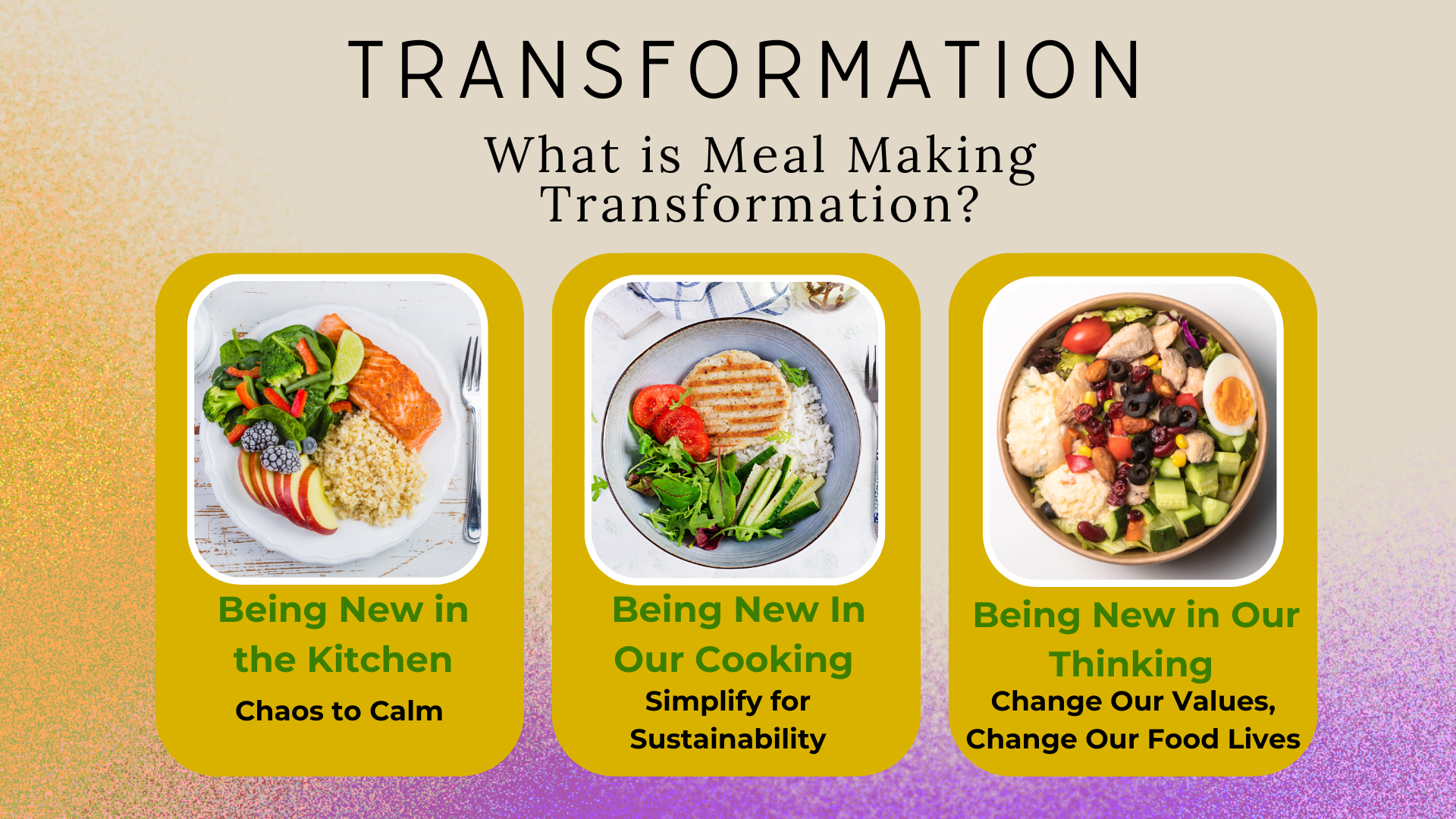
The previous section began the conversation around Meal Making Transformation. As mentioned there, the parts and pieces of Meal Making Transformation came to me bit by bit. Eventually they “self-organized” into three areas of “new-ness:” Being New in Our Cooking, Being New in the Kitchen and Being New in Our Thinking.
Put these three pieces together and you become a powerful, unstoppable meal making force, capable of easily and efficiently assembling meals that deliver good health. So let’s take a look at each of these areas:
Being New In Our Cooking
This piece of Meal Making Transformation is all about learning how “cooking” can be vastly simplified so it becomes entirely manageable and sustainable in our modern time-starved lives. Just a few basic techniques combined with just a few basic recipes (not hundreds and thousands!) makes it possible to create dozens of totally doable, deliciously healthful meals on a short timeline.
All too often, however, the thought of “cooking” brings up visions of slaving away for hours in the kitchen, trying to make some fancy recipe, figuring out what to make with it, hoping everything gets done at the same time and praying that it all turns out OK. In other words, “cooking” has a baggage problem
That’s why I used the words “Meal Making” in the phrase “Meal Making Transformation.” Being a new term, “meal making” is baggage-free. What’s more, it is a far more generous term that can include simple but healthy and tasty meals like wholesome sandwiches, hearty salads, easy skillets and quick soups and stir-fries.
This new way of cooking is what I have shared in hundreds of cooking classes and demos and I encourage you to check out the videos on my YouTube channel so you can get started and turn everyday healthy “cooking” into an entirely manageable and sustainable lifestyle.
Being New in the Kitchen
Believe it or not, the kitchen doesn’t have to be a highly stressful and crazily chaotic place where making meals is like pulling teeth. Turning the kitchen into an efficient cooking environment is a key piece of Meal Making Trans-formation. It provides the foundational structure, i.e., the infrastructure, necessary to be New in Our Cooking.
Creating a supportive kitchen is not as hard as it might seem. There are six, straightforward KitchenSmart® Strategies to guide the way. Bit by bit, as those strategies are put in place, the kitchen is transformed into your friend and ally on the healthy eating journey, i.e., a place where we can capably and naturally make meals that serve our health and fill our hunger for flavorful, yummy food.
Learning to be new in the kitchen is the subject of my first book, Take Control of Your Kitchen. I hope you will check out its step-by step guidance for putting the six KitchenSmart® Strategies to work in your kitchen. A wonderful surprise awaits as we transition from chaos to calm in the kitchen and find it to be a place of comfort, fulfillment, engagement and even fun.
Being New In Our Thinking
Although last in the lineup, becoming new in our thinking is actually the most important of the three areas of Meal Making Transformation. It’s how we “get our heads behind our actions.”
I have found that truly believing in the value of an action makes it a lot more likely that we will take that action. In the case of meal making, truly valuing it is the foundation that’s needed for successful, long-term change in the meals we assemble and eat.
I doubt there is anything too novel about connecting our values to our ability to make changes in our lives. However, I’m not sure we have considered how understanding the thinking-table connection could be the key to achieving the healthy eating success we long for. What if it is the missing link on the healthy eating journey?
Unlike the first two areas, however, I have yet to develop a comprehensive resource on Being New in Our Thinking. Over the last several years, however, it has become ever clearer that a thinking transformation is the key to healthy eating success–and in fact is really the critical first step. That’s why this booklet is devoted to this area of Meal Making Transformation.
But are you scratching your head wondering what in the world does thinking have to do with making healthy meals? That may sound far-fetched. But the next segment will shed more light on the Thinking-Table Connection.
Section 3: The Thinking-Table Connection
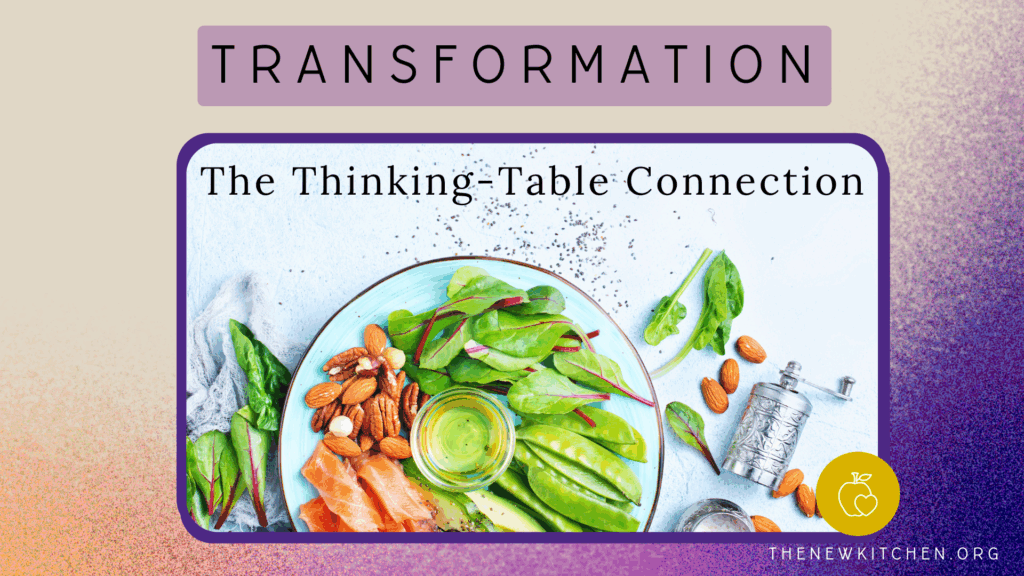
Maybe we don’t often think of the humble kitchen as a place for something as lofty as a “transformation.” But wait until you read what follows!
Section 1 listed the amazing wealth of resources available to help us adopt a healthy meal making and eating lifestyle, from thousands of cookbooks and millions of recipes, to hundreds of cooking shows, nutritionists and diet books. By all rights, we should be the healthiest population on the planet! Yet still we struggle.
That’s why I have to question:
With all our resources, why do we still struggle to make and eat good meals? The answer, I believe, lies in understanding the difference between surface level resources and the deeper level resource of our thinking.
Instant Pots
Indeed, the resources listed above are wonderfully helpful, but only at a surface level. For example, when Instant Pots arrived on the cooking scene, they were an immediate hit. A couple friends hauled the heavy things home, excited by the prospect of Instant Meals.
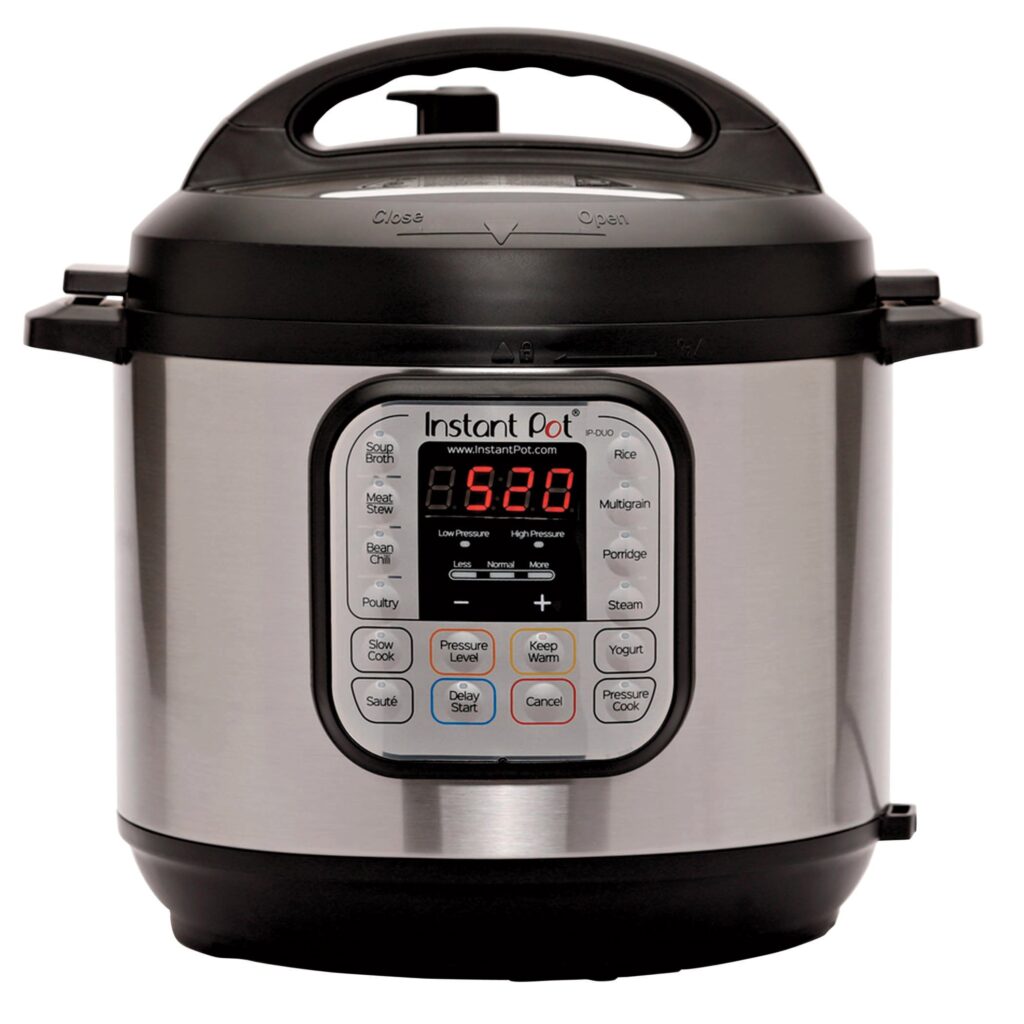
However, Instant Pots don’t actually produce Instant Meals! They still require the same amount of meal prep as a regular skillet or soup pot.
The onions still have to be chopped and sauteed, the spices added, and the vegetables cut and stirred in. It is only the actual cooking step that would be more “instant”–and that is a hands-off step anyway!
For all our helpful resources, then, the fact remains that none of them jump up and make healthy meals on their own. In other words, they are helpful at a surface level, but somebody has to exert time and effort to put them to use.
New Thinking
Whether to exert that time and effort is driven by our deeper level thinking, i.e., by what we value and believe to be a worthwhile use of our time. Unless we truly value meal making, what are the chances we’ll put that Instant Pot or any other helpful resource to work creating healthy meals?
I can say that my two friends’ Instant Pots have been relegated (pretty permanently) to a bottom corner cupboard in their kitchens! Though well-intentioned, these two home cooks did not have the thinking level support necessary to figure out how to use an Instant Pot, find good Instant Pot recipes, and then do the chopping, sautéing and mixing needed to prepare a recipe for Instant Pot cooking.
This is where new thinking comes in. What if we so deeply valued our health that we were compelled to deeply value the meal making that sustains our health? An interesting thing happens when the mind truly and deeply values something. That something begins showing up in our lives–and very often without a lot of stress or struggle.
The Thinking-Table Connection
The bottom line is that there is an intimate connection between our thinking and what shows up on the table. Our thinking and values have a lot to do with our actions and priorities. Change our thinking and values and our actions and priorities follow along, like the desire to make and eat better meals.
I have to wonder whether this thinking-table connection might explain why so many New Year’s Resolutions around healthy eating often fail to materialize?
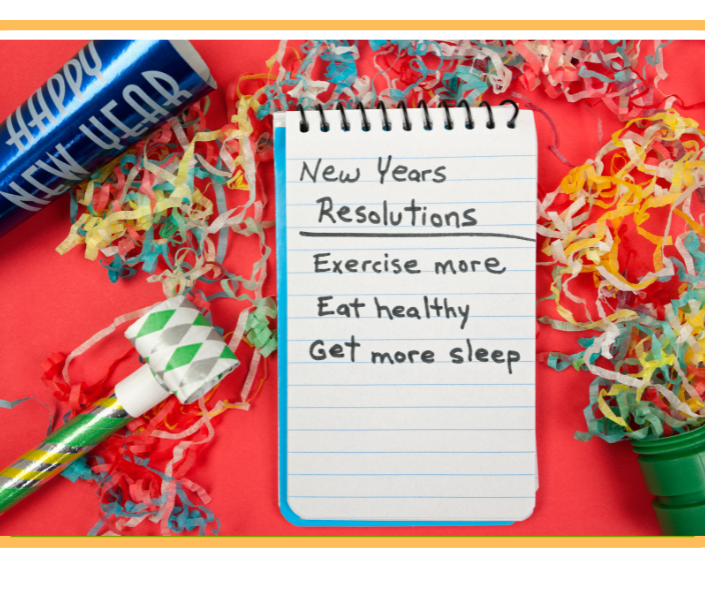
Maybe it’s not that we don’t structure those resolutions the right way, make them SMART enough, schedule them into the calendar or parcel them into manageable small steps.
Maybe it’s because we don’t want them deeply enough, i.e., they aren’t really backed by the deeper level force of our thinking, beliefs and values.
After all, who wouldn’t resolve to eat better each January? It’s an almost universal hope and dream. However, taking the patient, day by day, not-very-glamorous-steps to make and eat better meals pales next to the many other exciting and attractive priorities vying for our attention, like shopping, social media, socializing, an exciting work project or a vacation.
The Buying Trap
In lieu of taking those not-very-glamorous steps, I often see people substitute the quicker and easier option of buying more helpful surface level things, like a new healthy cookbook, a session with a nutritionist, an armload of fresh fruits and vegetables, a diet book, a weight loss app-–or an Instant Pot!
Of course these are all good steps, and they can make us feel productive-–like we’re making progress. But can and do they lead to lasting change? Probably not, without the deeper force of supportive thinking and values that is needed to put those purchases to work.
Could things be different if we diverted energy instead to exploring our thinking, beliefs, attitudes and perspectives around the kitchen and cooking. For example, do we truly value cooking or does it seem like a trite and annoying intrusion on the day, best dispensed with as quickly as possible?
As mentioned at the outset, maybe we don’t often think of the humble kitchen as a place for something as lofty as a “transformation.” But I hope you’re seeing some hopeful possibilities here!
Section 4: What Does New Thinking Look Like?
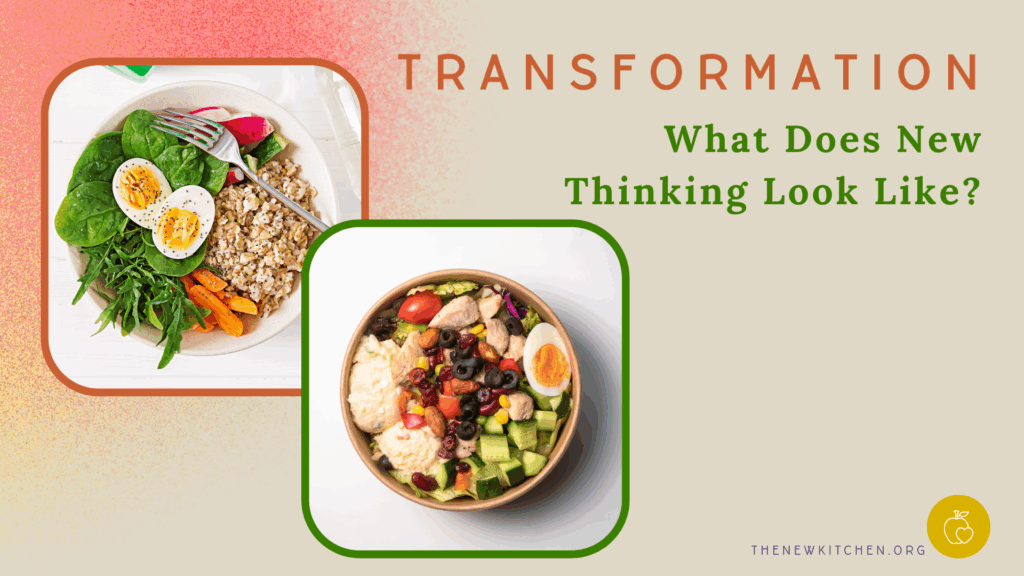
It’s time to see exactly what deeper level, “new thinking” looks like, i.e., what do we believe to be worthwhile uses of our time?
The last section explored the difference between surface level resources and the deeper level resource of our thinking. It explained how a deeper level shift in thinking is key to putting helpful surface level resources to work–-like Instant Pots!
You could say that the first two Meal Making Transformation pieces, Being New in Our Cooking and Being New in the Kitchen, are both “surface level” solutions.
In other words, turning the kitchen into a healthy eating ally involves taking certain defined physical steps, like creating a helpful pantry, learning to shop with a list, getting in the habit of planning meals, and so on. Similarly, simplifying cooking involves learning a couple defined techniques and then utilizing them with a few basic recipes.
After many years sharing and teaching about Being New in the Kitchen and Being New in Our Cooking, I had to admit that there’s nothing too hard to understand about them. It became clear that devoting the time and effort to DO them is the challenging piece of the puzzle. And that piece is driven by our deeper level thinking, i.e., what we believe to be worthwhile uses of our time.
Value and Respect
Two key aspects lie at the heart of this new thinking, both 1) value and 2) respect—for food, eating, the kitchen and cooking.
My research and experience in the field has revealed that value and respect are in short supply in today’s food world. This is understandable given the marketing directed at us over the last six or seven decades by a convenience food industry intent on keeping us out of the kitchen. By persuading us to steer clear of the stove top, we became reliant on and eager purchasers of, convenience foods.
The downside, of course, is that our health has been seriously compromised as our diet has shifted to processed convenience foods and away from real, whole foods prepared at the kitchen stove top.
For many years, I went right along with industry marketing, eating more and more processed foods and distancing myself further and further from the kitchen. Eventually, I came to view cooking as unexciting, unimportant and even irrelevant. I even became fairly embarrassed about spending time in the kitchen.
In other words, I had little to no value or respect for cooking. I most certainly did not view it as a worthwhile use of my time. This perspective was seriously challenged when my family faced our health crisis–because it turned out that making and eating vegetable rich, allergen-free meals is what healed us!
Suddenly, I realized that food matters. Really.
And with that realization came the obvious realization that the ability to cook that food, the kitchen where I cooked it and the table where we shared it were also very, very important. In fact, they could be called “healing modalities.”
Of course these insights didn’t come right away. For quite some time, I ranted and railed against the seemingly unending chore of making healthy meals, three times a day, every day of the week. Meanwhile, all my friends were merrily dispensing with mealtimes by relying on takeout meals, fast foods and Friday night pizza. I felt terribly put upon!
What Changed?
Regaining my and my family’s health is what began shifting my perspective. How could I deny the connection between the food I was cooking and the amazing health we began experiencing? And unquestionably, that health was far more satisfying than any pizza, McDonald’s happy meal or drive-through burger!
It had been a long time since I really felt good health, however. So until I experienced it, I couldn’t imagine it could be worth the effort of making our own, health-giving meals. So what a pleasant surprise to discover such a wonderful payoff for my meal making efforts!
I wonder if others have a hard time even imagining this kind of wonderful health payoff, simply because we can get so far removed from what true good health feels like.
At the outset, then, I valued the kitchen and cooking just because they delivered good health. Gradually, however, I also came to value and respect them in their own right, because they are part of our essential humanness, i.e., part of what we do to survive.
For centuries and centuries, humans have been gratefully reaping the foods nature gives us and cooking them, even if only over an outdoor fire.
The Blue Zones
Maybe 20 years ago or so, researchers discovered several Blue Zones around the globe where people regularly live to over 100 with few to no chronic diseases. A number of factors were discovered that contributed to this astounding outcome, from family and social connections to natural movement, and from relaxation and life purpose to, or course, a healthy diet.

Interestingly, I have seen many articles dissecting variations in the diets of different Zones to determine which of their foods are the magic elixirs that deliver good health. However, the Blue Zone populations didn’t follow any particular “diet.” There were none of our modern diet and nutrition books, podcasts and studies that were imported into these traditional communities!
Instead, these populations simply ate what every population ate in times past: They ate what nature provided in their locale since foods weren’t shipped in from around the globe! Instead, people simply ate whatever they could fish, farm, raise, hunt or gather from their region. Naturally, then, their diets varied depending on where they lived.
Regardless of what a particular population did or didn’t eat, however, the key fact is that diets in all the Zones were comprised of real whole foods. And those foods didn’t come in a microwaveable packages. They had to be cooked. That means someone was cooking them, day in and day out, year after year.
Clearly, then, in addition to the composition of Blue Zone diets, cooking is an equally important factor explaining health success in these areas (even if none of the expert research mentions it!) Without that key activity, there would be no amazing Blue Zones populations.
This raises a critical question. I had always felt so irritated and annoyed having to cook healthy meals three times a day, every day of the week. How did and do people in the Zones regularly cook their meals–and likely as not without the aggravation and angst that I felt?
I’m guessing it is because in the past, people didn’t have the luxury of stopping by a fast food joint down the street or microwaving a frozen meal! So as people have done for centuries, they cooked so they could survive! And because cooking was so central to survival it was naturally accorded great value and respect.
Even more interestingly, even though convenience foods are now available, these populations don’t seem to have been affected by convenience food marketing. They haven’t been convinced to believe that meal making is old-fashioned, trivial or irrelevant.
So they have never been lured from the kitchen and the traditions of cooking their own meals from real, whole foods. Consequently, they have been spared the health ravages visited upon other populations by the advent of processed packaged foods that are admired because they require no or minimal cooking.
Blinded by a Myth?
Reading about the Blue Zones made me wonder: The convenience food industry has led us to believe that cooking is inherently tedious and tiresome.
But what if the industry’s portrayal of the kitchen and cooking isn’t objectively true? Is there actually any “evidenced based,” “scientific study” objectively proving that cooking lacks value, is impossibly difficult or is excessively time-consuming?
Or is cooking’s negative reputation merely a subjectively created narrative–a myth–created by clever marketers?
Actually, there is nothing more reprehensible about cooking than any other of our daily activities, like driving to work, doing the laundry, feeding our pets, cleaning the house, gassing the car or grocery shopping. People have been cooking for centuries without it being considered an unduly onerous activity. And in terms of time, certainly the health-supporting activity of meal making is as worthwhile as all our television and social media time!
However, creating a subjective narrative that devalues and denigrates cooking has an advantage for its marketing creators: It forces us into the (very profitable) processed convenience foods trap.
In the next segment I’ll talk more about “normalizing” cooking, the role of limiting beliefs and a radical proposition for a new food world.
Section 5: “Normalizing” Cooking, Dealing with Limiting Beliefs, and a Radical Proposition
The previous section revealed the two key aspects at the heart of new thinking, both 1) value and 2) respect–-for food, eating, the kitchen and cooking. Now let’s further explore other key aspects.
The previous section ended with these inquiries: The convenience food industry has led us to believe that cooking is inherently tedious and tiresome. But is there actually any “evidenced based,” “scientific study” objectively proving cooking’s lack of value, impossible difficulty or inherently excessive time requirements?
Or is cooking’s negative reputation merely a subjectively created narrative–a myth–created by clever marketers?
“Normalizing” Cooking
The more I stepped back from my conditioned way of thinking and considered my kitchen situation from an objective perspective, the more my mind opened to the possibility that maybe cooking was OK.
Maybe it was only because my mind had been programmed otherwise that I resented my time in the kitchen so much. That, in turn, made my time there more stressful and aggravating than it needed to be.
Over the years, allowing myself to follow this new train of thinking has mellowed my feelings around cooking. Certainly, there are times after a long day when I wish there were some leftovers in the fridge for dinner!
For the most part, however, meal making has become just a routine, normal part of my day. It doesn’t provoke thoughts or feelings much different than those that arise from checking emails, paying bills, taking a morning walk, getting ready for bed or any other part of my day.
In other words, everyday meal making is just not a big deal anymore. It has become “normalized” in my life.
Fight or Make Peace
Interestingly, making peace with cooking and kitchen has led to has led to a number of additional, surprisingly pleasant discoveries, e.g.,
- It can be a welcome tactile respite from typing on a computer all day.
- Handling living fruits and vegetables adds an aliveness to my day.
- Chopping, stirring and mixing is almost like meditation, helping me de-stress.
- Not having to concentrate on work provides time to call and chat with friends and family while I cook.
- Finally, cooking offers a rare opportunity to exercise a little creativity.
A Thinking Transformation
Who would have guessed that cooking could be not just OK, but pleasant and even fun!
But only by thinking for myself, objectively and outside the box was I able to make these discoveries. They liberated me to freely and even enjoyably make the meals that kept me and my family healthy.
I hope my story has given you a good sense of what it means to transform our thinking. I began our healthy eating journey being dismissive of the kitchen and resentful of the time I had to spend making health-giving meals. It was only a change in my thinking that paved the way to turn wholesome meal making into a consistent, manageable, lifelong lifestyle.
Limiting Beliefs
My thinking transformation took a few years, since I had no idea how much our thinking and beliefs impact our actions. Nowadays, the negative impacts of our thinking are called “limiting beliefs.” No doubt you’ve heard this phrase and how we have to root out and address limiting beliefs to successfully achieve our goals.
Even if I had heard of the limiting beliefs concept, however, I would have assumed that this lofty self-help idea had no applicability in the humble kitchen. Yet experience has shown me that there is a very real connection between our thinking and beliefs and what shows up on the table, as shared in Section 3.
So actually, the kitchen and cooking are not only perfect but very timely places to apply the self-help principle of limiting beliefs.
I hope that transforming your thinking and getting past limiting beliefs are ideas that will be valuable on your health journey. Granted, they may sound strange right now since, as mentioned earlier, few people have considered the impact of our thinking and beliefs on our ability to make and eat the health-giving meals our bodies crave. Hopefully, however, sharing my story will encourage and speed your understanding and acceptance of this novel thinking-table connection.
A Radical Proposition
So to summarize, here is a radical proposition to consider:
- What if we value our health so much that it inspires us to take a close look at our thinking around meal making?
- And what if we are further inspired to transform our thinking so it supports putting out the time and effort to Be New in Kitchen and Cooking?
- What if, instead of fighting them, we make peace with the kitchen and cooking?
- And what if all of this turned healthy meal making into something that is entirely manageable, engaging and even enjoyable in our modern lives?
- Would these be worthy areas of exploration–and could they lead to a wonderful result??
And finally, one last question to ponder in the days ahead: Is there a valid reason why we shouldn’t honor the life-giving practice of making our daily bread and nourishing our precious bodies?
Section 6: How Do We DO a New Thinking Transformation?
What’s the Formula?
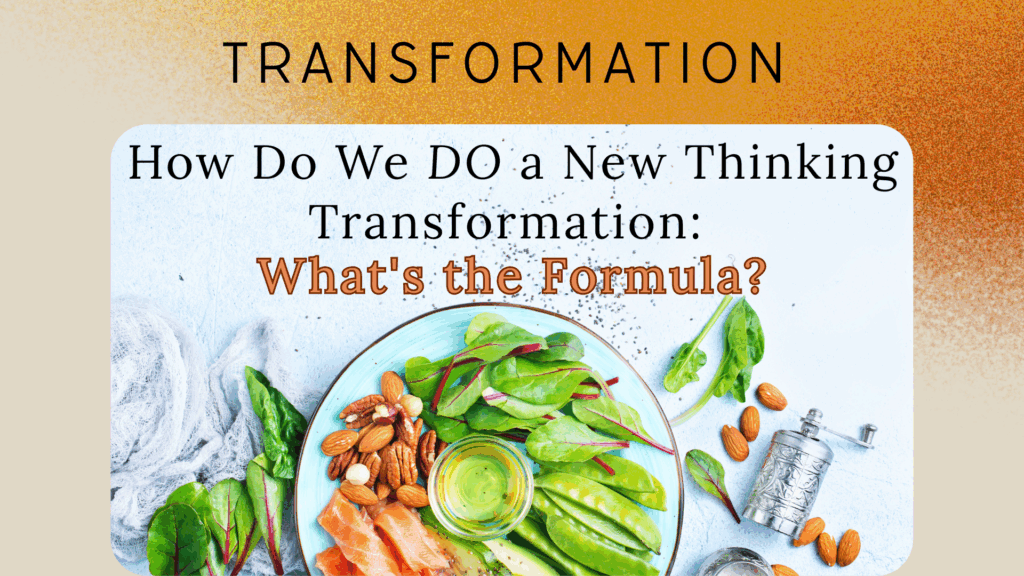
This is the last of six sections on Being New in Our Thinking. Knowing what deeper level “new thinking” looks like, we can now explore how to make a new thinking mindshift and enjoy the many positive benefits it brings.
The neat thing about undergoing a thinking and values shift on the inside is that life on the outside changes to match–very often without a lot of struggle, stress or sacrifice. That’s because our true and deepest thinking and values are what drive our actions. Change our thinking and values and our actions naturally and easefully follow along.
I hope you’re excited about the healthy eating opportunities that become possible with a supportive change in thinking. But how do you become someone who truly and deeply values and respects food, eating, the kitchen and cooking—so that your thinking can then support healthy meal making? And how do you do this when we are immersed in a culture that encourages and even glamorizes just the opposite?
The Formula for a New Thinking Transformation
Step 1–Thinking for Ourselves
Here’s the thing: This entire series is about changing the way we think, which then leads to a beneficial shift in our values. However, this beneficial sequence presupposes that we are in control of how we think! And that is not necessarily true, as surprising–and alarming–as that may be!
Section 4 explained how we have been the target of a vast marketing campaign over the last six or seven decades. It was undertaken by a convenience food industry intent on keeping us out of the kitchen for this simple reason: By persuading us to steer clear of the stove top, we became reliant on and eager purchasers of convenience foods.
As also explained earlier, for many years I went right along with this marketing message, eating more and more processed foods and distancing myself further and further from the kitchen. Eventually, I even came to view cooking as unexciting, unimportant and even irrelevant. In other words, I had little to no value or respect for food, eating, the kitchen and cooking.
The first step in my journey, then, was regaining control of my thinking enough to steer it in a more beneficial direction. In other words, I had to start thinking for myself.
So instead of just operating on autopilot:
- I had acknowledge the uncomfortable fact that something wasn’t quite right about my eating habits.
- I had to put a little time and effort into examining that unease instead of pushing it away and continuing blindly down the same dead end path.
- I then had to work up the courage to begin questioning all our culture’s norms, assumptions, values and beliefs around food, eating, cooking and the kitchen.
- I had to be daring enough to think and act differently from all my friends, family members and the wider community.
- Once freed from all the limiting beliefs that had trapped me, I could begin looking at things from a fresh, new and objective perspective.
- Eventually I was able to create new values and beliefs that served my best self-interests, rather than the interests of the convenience food industry.
- Included among those new values and beliefs were honoring and respecting the kitchen and cooking instead of being resentful and dismissive of them.
So step one for Being New in Our Thinking is simply this: getting in the habit of thinking for ourselves instead of outsourcing our beliefs, values and thinking to the convenience food industry.
Step 2–Harnessing a Little Righteous Anger
Thinking for myself made it possible to consider my food situation dispassionately and logically. Viewed this way, it became crystal clear that I had been hoodwinked, and for a long time. That’s when I got a little miffed–even angry!
Do I really want to let myself get tricked into eating food that harms me?! Am I not smarter than that?! Don’t I deserve better?!
Of course, uncontrolled anger is not a good thing. However a little righteous anger made it easy to exit the convenience food scene and cemented a desire to make my own, real whole food meals.
Step 3–Firing Up the Imagination
Change leaders often say that change won’t come unless we can envision something better. Without a guiding vision, we are just wanderers in the desert.
Honestly speaking, I didn’t have a vision to guide my journey to a new way of thinking and eating. That’s because I didn’t know I was up against a cultural force trying to keep me stuck in an eating sinkhole. I didn’t know that I needed a new way of thinking, much less could I imagine a vision of what a supportive mindset might look like.
Hopefully, you are now in a better position than I was. The previous segments have clarified why a positive guiding vision is needed, while also offering a good starting point for creating a helpful vision.

Although my vision was late in coming, I now envision a life and community wherein meal making is so valued and respected that we celebrate the opportunity to take good care of ourselves and we treasure the simple act of making and eating meals that delight and nurture us.
Step 4–Spotting Your Inspirational Spark
Closely related to firing up our imagination is finding an inspirational spark to ignite the change process.
The reason is simple: Change is almost always challenging, especially around our thinking. And even more especially for food-related thinking, since we are immersed in a food world brimming with health-destroying options that are irresistible. Absent a possibility for something bigger and better, of course we won’t exit this carnival of tempting options!
An inspirational spark is exactly the “something bigger and better” that can help us overcome the allure of all the tempting options so readily available in our food world.

A Health Crisis as Inspiration I always thought that our family health crisis was the inspirational spark behind my thinking and values shift. Indeed, that crisis got me moving! It got me in the kitchen making three meals a day so we could successfully regain our health. But as shared earlier, I felt terribly put upon and even resentful of that daily duty. There certainly wasn’t much fondness, much less value and respect for meal making.
Wonderful Good Health as Inspiration Rather than the health crisis itself, it was what happened after the crisis that inspired my thinking and values shift. Gradually, I got to experience feeling good again–no bloated stomach after every meal, no airborne allergies taking me down, no more colds and flus, no more complete exhaustion, no more need to gulp down Tums® every other day.
As shared in a previous segment, the lights went on as I realized the connection between the amazingly good health I was experiencing and the food I was making and eating. How could I do anything other than value and respect the cooking that transformed real, whole foods into health-giving meals. That daily ritual was giving me health, energy, joy–and life!
It’s an unfortunate fact that for many people, it takes a health crisis to get moving in the direction of healthier eating, as it was for me. If you’ve had to experience a health crisis, then maybe an inspirational spark can come from simply taking time to connect healthier meal making with feeling better, having more energy, and not getting drug down as much by pain and illness.
By nurturing an appreciation for feeling better, perhaps you can kindle some warmth and friendliness-–and eventually value and respect–for the cooking that delivers those benefits.
A Step of Faith as an Inspirational Spark Perhaps you haven’t realized any inspiring health breakthroughs from your healthier eating efforts? Or maybe you haven’t experienced any huge health issues but still feel compelled to start eating better. Or maybe you are facing health issues but haven’t yet begun changing the way you eat.
Absent any external health benefits to spark change, you may have to draw on an internally generated inspirational spark. Admittedly, there is precious little in the mainstream that would inspire faith in the wonderful health benefits of eating well. But step outside the mainstream and the evidence is plentiful!
There are so many podcasts, books and articles (like mine!) that share the stories of people (like me!) who have realized wonderful good health and even cures for chronic disease simply by eating better and making other lifestyle changes!
And unlike corporations promoting highly-profitable, health-destroying foods, these emissaries of good health aren’t reaping millions and billions by advocating healthy eating. Most are just excited to help others experience the same wonderful health that they have experienced.
Granted it’s hard to believe that you can experience the same health benefits as people who have already met with success. Especially since many of them have become famous book authors, podcasters and even celebrities. But our bodies were designed for good health when fueled and cared for properly. It really does happen! There is no reason we can’t all share in the goodness of health.
Good health may take a while, but here’s the hopeful fact. As soon as you start taking small steps, you’ll begin noticing small improvements.
Taking those first small steps is where the step of faith comes in. As you start experiencing small glimmers of hope, draw on them to generate the bigger inspirational spark needed to maintain the daily practice of healthy meal making. Finally, as the health benefits pile up, see if you don’t begin befriending and embracing the kitchen and cooking as your allies on the healthy eating journey!
And there’s also something to be said for the point when you start realizing the joy of making a good meal that takes good care of you–and then sitting down to enjoy it! What a lovely addition to life!
Other Inspirational Sparks Of course there are many other sources of inspiration in addition to good health. Experts sometimes refer to them as “Big Whys,” e.g., things like being able to travel, staying mobile and independent, playing with the grand kids on the floor, and not becoming a burden on family. Interestingly, however, all of these examples depend on having good health to begin with!
A Couple More Pieces of the Formula
Besides getting in the habit of thinking for ourselves, imagining a guiding vision, and finding an inspirational spark, here are a few other pointers for becoming someone who truly and deeply values and respects food, eating, the kitchen and cooking.
Continuous Immersion I regularly read articles and listen to podcasts about various aspects of good health ranging from exercise to stress relief and from good sleep to, of course, healthy eating. This habit provides good positive reinforcement for my efforts, along with many helpful ideas and inspiration.
Staying on Top of Resistance Don’t underestimate the mind. Very often, only by dragging it kicking and screaming will it change. That is perfectly normal, since brains seem to prefer the status quo. Don’t let it deter you. Be gentle but firm–much like disciplining a rebellious 2-year old!
Seeing Yourself in a New Way Right now, you might see yourself as someone who just punts when hunger strikes, or someone who never thinks about meals, or someone who just resorts to convenient grab ‘n go. Part of a thinking change is seeing ourselves in a new way.
Try acquainting yourself with a new someone for whom it is perfectly natural and normal to throw together a health giving meal–even if it’s just a simple but filling salad, stir-fry or skillet or just a deli chicken breast, microwaved potato and steamed broccoli.
Finally–Resting and Getting Comfortable for Life The first stages of change are always the hardest. But over time, a new way becomes the normal and usual way. That will happen with healthy meal making, at which point Meal Making Transformation will have taken root!
Settle in and get comfortable for life–and begin enjoying the many upsides of meal making, like more creativity, good taste, stress relief, money savings, and even a little fun–all in addition to better health!
To your health and happiness, for life!
Learn More
Join our newsletter community for weekly tips, recipes, food news and motivational articles. Plus get 3 Free Gifts.
*Quick Cook Guide: 5 Ways to Take the Boring Out of Broccoli”
* Short how-to e-book on setting good, achievable eating resolutions
* Follow-along cooking class video on sautéing delectable chicken breasts with a simple sauce.