
“Cooking last week was so tiring and, frankly, just plain burdensome.”
So concluded Kris, one of the participants in a class I taught recently. I loved her honest assessment of the previous cooking week, especially the word “burdensome.” What a “perfect” word! I had never attached that word to daily meal making but it really hits at the core of cooking and kitchen issues.
Now for the obvious question: Does Meal Making Transformation offer any solutions for the burdensome-ness of daily cooking?
As you know, Meal Making Transformation is all about embracing the kitchen and cooking as friends and allies on the healthy eating journey. Transformation begins by elevating our thinking around the daily act of meal making, a notion that can seem strange when cooking is something we’d very much like to NOT think about.
But there is an intimate connection between cooking and the vibrant health we’d all love to experience, i.e., cooking is how we are able to consistently make and eat the real, whole food diet that is a key part of good health (as is now recognized in the 2026 Food Pyramid.)
Yet it’s undeniable that the daily act of cooking can be burdensome. It’s just the nature of the activity because it takes time, effort and energy when we’re usually short of all three! The critical question, however, is where do we go with that fact?
- Do we let it stop us from making health-giving meals so we are forced to give up on our healthy eating hopes and dreams?
- Or might there be a way to shift our thinking in a way that offers a more helpful–maybe even transformative–perspective on daily meal making which, in turn, can keep us on track with our healthy eating goals?
Here are some of the thoughts I’ve had since that recent class.
Mind the Connotation Could we look at a burden as not so burden-some?
Technically, an activity is deemed burdensome if it involves some kind of burden, i.e., a load, duty or responsibility. So although burdens aren’t necessarily undesirable, we usually associate them with things we’d rather not do. But is there a different way of looking at life’s “burdens?”
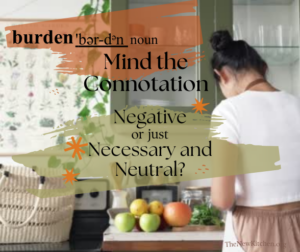
Life is actually full of burdens: going to work each day, gassing the car, taking the kids to the sixth activity of the week, getting your teeth cleaned, feeding the pets, cleaning the bathroom, etc. etc. But being burdensome doesn’t stop us from doing these things! Probably because we value the financial stability, orderliness and ease that comes with attending to life’s various parts and pieces.
For that reason, I’m guessing the burdens above aren’t saddled with a negative connotation. Rather they are likely just viewed as neutral and necessary, i.e., the normal stuff that has to be done for a manageable life.
Could meal making be viewed in a similar way? Maybe not a favorite activity but at least one that is in the “neutral and necessary category,” i.e., just something that has to be done each day because we value feeding ourselves in a way that maintains health?
The Ebb and Flow Assigning meal making to the neutral and necessary category might also help relieve some of the pressure that can often accompany it. For instance, Kris from yesterday’s class shared that the first week after the holidays, she planned out and prepped meals for the following week and mealtimes were great.
But the weekend after the first week of work she was more tired, had a lot of things to get done over the weekend and didn’t feel quite so motivated. She still planned and prepped week two’s meals and they were ok, but as mentioned earlier, “cooking was tiring and felt really burdensome.”
When it comes to cooking and meal times, there’s an ebb and flow. Not every day is a carnival. As with every other part of life, from work, social interactions, moods, exercise and so on, there are ok, good and better days. And that’s perfectly fine. No need to feel something’s amiss with “just ok” days.
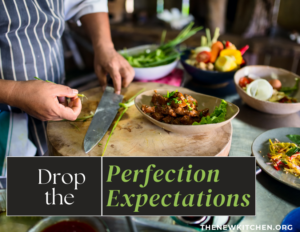
De-Pressurizing Part of Meal Making Transformation is letting go of “perfection expectations” created by restaurants, podcasts, TV shows and especially social media. The perfect-looking meals in those arenas make us think that meals have to look a certain way, taste a certain way and create perfect happiness at the dinner table–all of which adds a lot of stress to meal making. Permission is hereby “granted” to be 100% ok with less than perfect meals!
Relativity Bear in mind that the connotation we assign meal making–neutral or negative–depends on what our brains are comparing it to. For instance, at the end of a long day, anything other than propping our feet up and watching a favorite TV series will seem burdensome! When I have a burdensome-feeling day, I do two things:
- keep the meal as simple as possible and skip any fancy additions; and
- focus on how relaxing it will be–and how much better I will feel–after sitting down to a nourishing meal, even if it isn’t fancy or perfect!
Happily, because the burdensome level of daily meal making is relative, a less-than-positive assessment is not fixed in stone and can change from day to day. This gets into the importance of Practice.
Practice There’s one common denominator among people who are good at something: They didn’t get there overnight! Rather it was through practice, practice, practice. In the case of meal making, the goal is not to become a gourmet chef, but to just become reasonably competent so making decently good meals is not a big deal.
A little known secret is that it doesn’t take a lot of practice to become reasonably competent. Becoming a decent everyday cook requires only a few basic cooking skills, six basic kitchen skills and a dozen or so pieces of equipment. Forget about all the celebrity chef nonsense floating about the food world. Just keep showing up day in and day out and watch as meal making becomes normal and natural–and shifts into the “neutral category” of burdens.
And don’t be surprised if you even begin enjoying cooking a little as meal making becomes easier, more routine and more successful.
Touch into the Goodness When describing her great cooking week, Kris mentioned how she felt proud of herself, that meal times felt under control and how it felt good to take good care of herself and her family. As mentioned above, warm and fuzzy feelings around mealtimes ebb and flow, but keeping the good times in mind helps power us through the low days–which is exactly when Negative Grinches get busy weaseling their way into your brain and scheming to sabotage your efforts.
Good Health Isn’t Free Many of the activities in our lives are optional, or can at least be delayed for hours or days. Maintaining our health isn’t that kind of activity.
The same goes for supplying our bodies with the real whole foods that deliver good health. Meal making isn’t something we can ignore, avoid and run from.
The price of health, then, is effort, time and attention.
As mentioned in my booklet, which shares my Meal Making Transformation journey, I eventually came to realize that I could fight the kitchen and cooking as impositions on my busy life. Alternatively, I could make peace with the skillet and embrace the kitchen and cooking as my friend, ally and actually, a critical pathway to the lifelong vibrant health and good energy I wanted.
So, What Does Thinking Have to Do with Healthy Eating?
Maybe you noticed something from Kris’ story: Her “cooking” issues didn’t have anything to do with cooking itself. She planned, prepped and executed meals just fine her first week after the holidays. And it appears that she accomplished the cooking part just fine the second week, too. The problem during the second week lay in the mind traps her brain kept springing on her, i.e., this is so tiring, so burdensome, etc.
Of course there is nothing wrong or very unusual with these kinds of thoughts. What’s important is to realize that the problem is a brain problem, so it requires a brain solution, i.e., a shift in how the brain responds so it doesn’t submarine our healthy eating hopes and dreams.
This can take some time. Gradually allow the mind to be okay (maybe even enjoy) time spent cooking.
My best wishes for helpful and supportive thoughts for all of us!
1 thought on “What if cooking is just plain burdensome?”