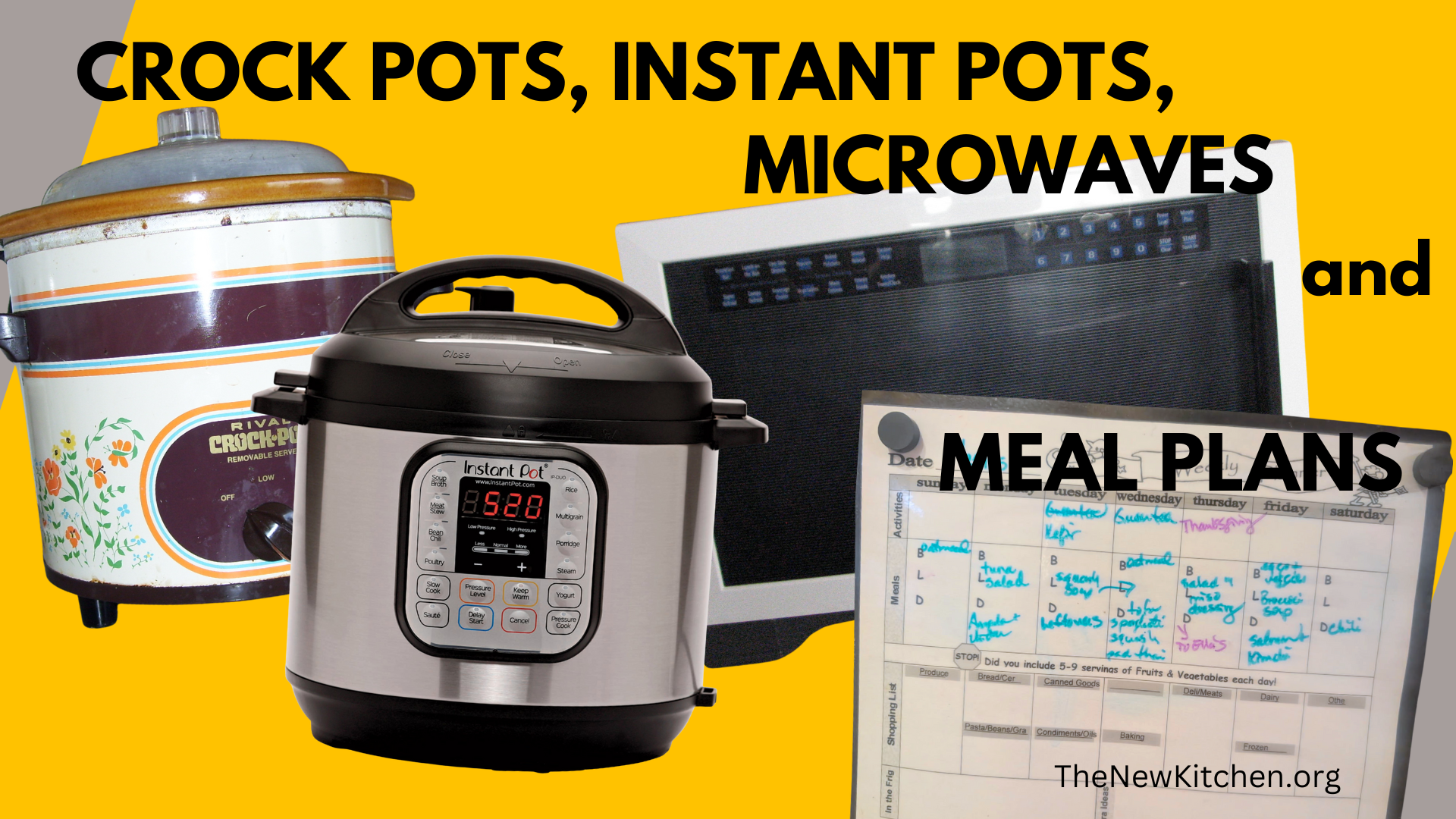
Who would have guessed that crockpots, instant pots, meal planning and microwaves would generate such interesting feedback? I got so many thought-provoking comments after the last couple posts that I wanted to use them as a springboard for further conversation.
Meal Planning
Here is Carolyn’s response to last month’s article on meal planning, “Why Most People Begin Cooking at the Wrong Time.” See if anything sounds familiar.
“The trap for me is getting absorbed in a project, losing track of time, and suddenly I’m hungry. Stress and panic set in. I don’t plan for a whole week because 1) I never know what I’m going to be in the mood for and 2) “best laid plans…” something comes up. But I do plan the day before. Since my cooking drive goes in fits and spurts, I do mass quantity when I’m in the mood, and portion and freeze. Then it’s just a matter of perusing the freezer for what I’m in the mood for and take it out the day before to defrost in the fridge. Or, I might look at the fridge, do a search on what’s there and let the Internet suggest a dish or two.”
Carolyn’s comments bring up so many insightful aspects around meal planning. Let’s take a look at them.
Comment #1: “Suddenly I’m Hungry”
This comment reminds me of how I always began my meal planning classes. “How many of you got hungry last night?” I would ask. Not surprisingly, everyone raised their hand. So I continued, “How many of you got hungry the night before?” Again everyone raised their hand.
I would conclude by asking, “Given that you got hungry the last two nights, what are the chances you’re going to be hungry tonight, and tomorrow and the next day?” While everyone chuckled when they saw where I was going with this little game, the more serious point became clear: Despite a nearly 100% chance of hunger appearing every day, it is surprising how often we are surprised when our stomachs start demanding food, which is when panic and stress set in.
Comment #2: “Panic and Stress”
Indeed panic and stress do set in because when hunger hits, it really hits!
Logically, reasonably and rationally, then, doesn’t it make sense to prepare for the inevitable arrival of hunger? That of course, is what the think-ahead-and-plan habit is all about, i.e., preparing for the inevitable so you have a decent chance of successfully meeting the challenge. 
What’s curious, however, is how often we fail to take advantage of this perfectly logical solution when it would be so beneficial! My thinking is that very often the logical part of the brain is out-voted by unhelpful mindsets. For instance, Christine, another reader, described her planning resistance as the feeling that “planning is a bigger hurdle than it actually is.”
Other thinking barriers I’ve seen over the years include:
- the desire for more spontaneous meal times,
- the thinking that meal planning is too trite and old-fashioned for our modern times,
- a resistance to making decisions, defaulting instead to putting them off and believing things will somehow work out, or
- some experience(s) in the past that set us against the practice or the kitchen and cooking in general.
If you grasp the logic of the planning habit—and want to replace stress and panic with calm and clear direction—can I suggest slowing down and exploring the friction and resistance that pop up when you sit down to plan. Here are two resources to help:
- Exploring obstructive mindsets is what Meal Making Transformation is all about so I do hope you’ll read/listen to my new booklet that shares how I dealt with problem mindsets.
- Also my online course on meal planning explores many common planning barriers and how to navigate around them.

Comment #3: “In the Mood”
People often hesitate to plan ahead for fear that a planned meal won’t be what they feel like when mealtime rolls around. All too often, however, I’ve observed that leaving your mealtime fate to the whims of mood leaves you at the mercy of ready-made or processed foods.
That’s because you can’t decide what you are in the mood to eat until it’s almost time to eat. Assuming you can even reach a clear decision about what you feel like eating at the last minute, do you have an actual recipe to follow, the right ingredients to make it and the time to make it now that mealtime is imminent? And will you be hampered by foods that required pre-soaking or thawing? All too often, last minute meal decisions force us to resort to quick and easy convenience options that don’t meet our health needs.
If this sounds like a familiar experience, consider some of Carolyn’s “in the mood” alternatives: First she stocks the freezer with meal portions from earlier batch cooking episodes, so she has a variety of “instant” options to choose from. Or she peruses her fridge and searches for a recipe to use those items. And she doesn’t actually wait until the last minute but plans a day in advance so she has plenty of pre-prep time.
Also remember, as mentioned in last month’s article, meal planning doesn’t have to look a certain way. Truth be told, I rarely plan for several days at a time but rather plan out each day’s meals in the morning. Usually, my meal decisions are vegetable-centered, i.e., what vegetable(s) need to be used up before they go bad. I then choose a protein and starch accompaniment that I can transform quickly into a skillet or stir-fry with some spice or condiment. Only occasionally do I make an actual recipe.
This approach works because I have an extensive food “inventory,” i.e., my freezer, fridge and cupboards are well-stocked with grains, beans, meats, fish, spices, condiments, nuts, broths and vegetables. So whatever I decide to make I’ll have the right ingredients and if any pre-prep is required, I take care of it in the morning.
This is not to say there’s anything wrong with writing out a formal plan, which is what I did for many years when my kids were young and more careful planning was critical. And it is the approach Christine often uses. But she also likes how last month’s article gave permission to just jot down ideas on a scrap of paper if that works better.
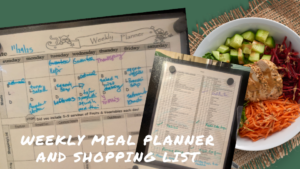
This is one of the plans included in my online meal planning course, which Christine laminated and posted it on the fridge. (You can print all three forms from class here.)
Comment #4: “Best Laid Plans”
One last insight from Carolyn’s comment: Regardless of whether you plan just one day or a week in advance, things can change. A friend invites you to dinner, you end up going out, a meeting comes up, etc. But just because plans can change is no reason not to plan for all the many, many times when things go as predicted. And for those times when plans change? Just push your plans back a day! Most meal ingredients will easily last an extra day or even two and if not, pre-cook and either refrigerate and pop into the freezer.
I don’t remember a change in plans ever leading to wasted food. If anything, it only made a plan last for more days!
So thanks Carolyn for sparking an instructive conversation! And now onto crockpots.
Crockpots vs. Instant Pots: It’s a draw!
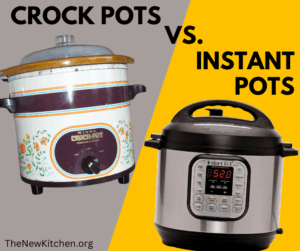
In response to my article comparing the two pots, I heard from both sides. Mary responded immediately: “I love my Instant Pot!!” In fact, she uses it “as a crockpot, a pressure cooker, to saute, and even parboil. I’m glad you endorse using instant pots!”
Kim, on the other hand, is a crock pot fan. “Crock pots are great! My brother gave me a mini one years ago, just right for one-person meals that can last 3-4 days.” In fact, she added, “I just picked up some stew meat at Natural Grocers and got my crock pot cooking!!
Kim added that her only problem is forgetting about her crock pot. She explained that “I’m very visual, so if things are behind cupboard doors I forget about them easily. But, since I started using my crock pot again recently, I’m remembering to use it more often. Plus I’m remembering to shop for the necessary ingredients TO use it more often!
Two of Kim’s points deserve emphasis:
- The Power of Habits So much of tasty, healthy meal making is about getting into supportive habits. If the crock pot helps get good meals on the table, do what it takes to make it habit-forming. The same goes for meal planning. After just a couple repetitions these become indispensable habits.
- The Support Team As I’ve mentioned in other articles, having a cool appliance does no good unless you also have meal ideas for using it and, as Kim mentioned, having the right ingredients on hand (which is another benefit of planning ahead!)
Christine falls in the middle of the debate: “I have both kinds of pots and appreciate your comment about using whatever helps me get meals on the table. In the summer I like the instant pot because I’m usually busy outdoors and don’t want to spend time in a hot kitchen. In the winter, though, I like the smells coming from the Crock-Pot and it makes me feel cozy.
Microwaves: Another draw!
The last post linked to a podcast where I talked about “Taking the Outrageous Out of Eating Well.” The host asked a question about my opinion on microwaves. He is firmly opposed to microwave use while I take a more relaxed view, a divergence of opinion that led to a couple reader comments.
Mary thought it was a little strange that my podcast host seemed so opposed to microwaves.
Kim, meanwhile, was so surprised to learn that I’m a microwave user. She continued, “I haven’t for years for all of the researched reasons. But, I also understand… it’s a bit wishy washy re: safety issues.”
Again, these reader comments raise some good points that deserve more exploration.
What Works? In the article on instant pots vs. crock pots, you’ll remember my bottom line: what works best for you to get health-giving meals on the table? For me, the microwave often makes it possible to make a satisfying meal when I’m crunched for time. For instance, I might race in the kitchen after an early workout having failed to cook any winter squash for a breakfast starch. Microwaved potatoes provide a quick solution.
An Interesting Discovery In one of our classes, we cooked zucchini in the microwave and everyone was surprised that it tasted so good. With that in mind, I tried microwaving beets a few days ago. I get a lot of them in my farm share and know they are very healthy, but darn they take a long time to cook! Again, the microwave worked a miracle on those tough characters–in just a few minutes they were soft, sweet and ready to eat.
Discovering a super quick way to get good-tasting vegetables into our meals is a fabulous find, especially given how often we’re about to sit down to a meal and oops, we forgot the veggies. Keep a stock of frozen veggies and it will always be easy to hurry some to the table.
Safety The wild card for microwaves, of course, is safety. In today’s world, safety is an increasingly significant element in almost every decision around food and eating. I totally understand that many people feel the microwave poses health risks, and I actually harbor some of those thoughts myself. As Kim acknowledged, however, the issue is not clear cut (although there is at least a pretty unanimous consensus to never microwave in plastic.)
So a suggestion is that if a “sixth sense” is steering you away from microwaves, then follow it! I’m in the middle, minimizing but not eliminating microwave use. There are many microwave options, of course, e.g, the stove, a toaster oven, even an instant pot. Kim actually uses her microwave to store small pans and lids that she can quickly access to heat food on the stove!
Thanks to those who watched the podcast. Loved Mary’s comment:
“I’m enjoying being in my pretty-well-organized kitchen listening to this video, cooking beans and tomatoes in my cast-iron skillet!” What a lovely picture Mary, especially with the onset of winter!