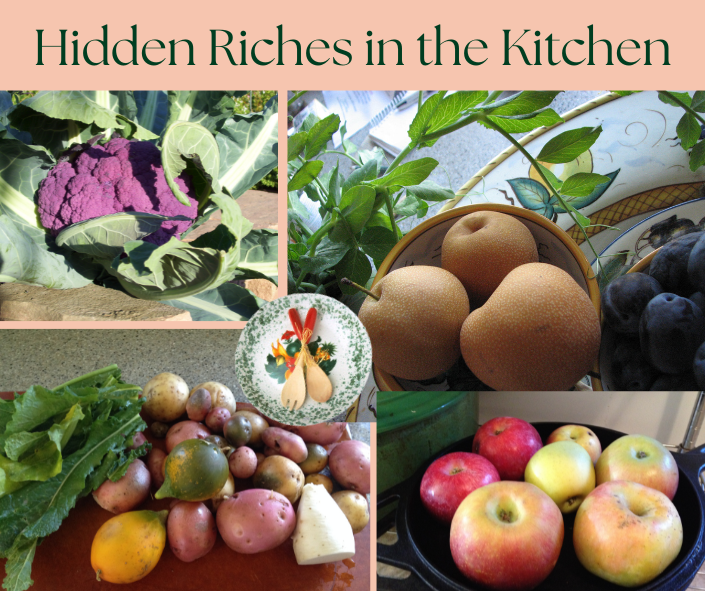
The kitchen has a reputation problem. All too often, it is seen as a place of toil and tedium, where it takes too much time to make food that “no one likes anyway.” That reputation has been created and carefully nurtured by our Convenience Eating Culture which prefers that we skip the kitchen and opt for ready-made manufactured food.
But here’s the thing: the kitchen actually offers us many riches. The problem is that they get no mention in a food world dominated by kitchen-free convenience foods. I’ve suggested as much for many years, but recently got some support in the form of an article about Victoria Wolff’s huge Instagram following. (1)
Wolff, who lives in a rustic cottage in the Scottish countryside, posts pictures of things like horses wandering into her rustic kitchen, copper pots hanging from the ceiling and pies made from blackberries picked in her garden, among many other scenes of “old-fashioned home life.”
The article’s writer was astounded: “Why are so many busy urban people drawn to Wolff’s Instagram account?” she asked. She believes it’s because “Wolff’s images are a bulwark against change at a time when things seem to be changing at an alarming rate.”
Lately I’ve been thinking about the alarming rate of change introduced by AI. Its “artificiality” is creeping into and radically changing our lives. We’re forced to constantly question: Is a picture real or fabricated? Was an article compiled by AI? (This one was not!) Is the person advising you on the phone an actual human? Will we even need our brains in the future?
Against this backdrop, the kitchen can be a blessed oasis of real-ness. Simply buy some real, earth-created food and bring it into the kitchen. Chop it, mix it, season it, stir it and create something real and tangible to savor.
For centuries and centuries, humans have been gratefully reaping the foods nature gives us and cooking them, even if only over an outdoor fire. Because this is a part of our essential humanness.
I have to think there is a good-ness here, in the kitchen, and also in cooking, food and eating. For too long, we have been robbed of this good-ness, lured away by the glitter and gold of modern convenience foods. As the article writer put it, Wolff’s images may well be “feeding a deep, childhood [maybe even ancestral] notion of home we carry in our heads.”
May we all be blessed with a pause at the start of this year to savor the hidden riches that patiently wait for us in the kitchen and at the table.
(1) “Why Are So Many Women Dreaming of Rustic Domesticity?” Katie Roiphe, WSJ. December 6-7, 2025, p. C3