
The next couple weeks are going to be make-or-break time for healthy eating resolutions. That’s when most of them fall by the wayside. So here’s a thought if you start missing the mark on one or more of yours: What if it’s not all your fault?!!
What if bigger forces are at work, diligently plotting to undermine your best eating intentions? Making matters worse, what if you don’t even realize that you’re up against a small army of very powerful adversaries?
That’s some comforting news, right? Of course it’s not permission to just give up. Rather, it helps us home in on a big part of the healthier eating problem that most of us don’t know about, i.e., how our food culture creates an environment where it’s almost impossible to stick to our better eating intentions. Being aware of this environmental adversary makes it possible to then home in on and develop the kind of muscles needed to succeed against it.
Sherri’s Story I connected with Sherri through LinkedIn and we decided to meet in person at a local coffee shop. We both got something at the counter before sitting down to chat. Along with her coffee she got a tasty-looking cinnamon pastry.

So we settled in and were ready to talk about my being a guest on her podcast when she blurted out what was first on her mind:
“Why am I eating this cinnamon pastry when I know it’s not what I really want to eat?”
The conversation quickly moved on, but her initial question kept coming back to me: “Why indeed do we eat foods that we don’t really want to eat?”
On an obvious level, it makes no sense. If we don’t want to eat something, why not just stop eating it–or don’t even buy or make it in the first place?! No one is holding a gun to our heads, demanding that we eat whatever treat might be tempting us.
Here’s the thing, though. Sherri questioned why she was eating a cinnamon pastry when she really didn’t want to. I am struck by a different question:
“How could Sherri not eat that pastry?”
Irresistible sweets and snacks are everywhere! This creates an unspoken assumption that partaking and treating ourselves is normal, acceptable, and almost expected. But while strong cultural signals are practically screaming at Sherri to buy and eat a treat, nothing supports her desire to avoid the temptation of a sugary treat.
New and Different Muscles Obviously, we’re trapped in an impossible predicament, trying to defeat an enormously powerful culture of temptation with our puny little individual willpowers. Surely we could use some additional and better firepower! Here are three new and different “muscles” we could develop to help:
Muscle #1–Stronger Awareness Over the years, as my awareness of our Temptation Culture has strengthened, I have become ever more shocked at how pervasive it is! What’s more, I have to admit that our culture’s programming doesn’t just go in one ear and out the other as we might suppose. Rather, it detours into the brain and lodges itself there permanently! This is exactly what it was designed to do by psychology experts! (Ever notice a catchy jingle looping endlessly through your brain?!)
So can I suggest an additional New Year’s Resolution: Commit to consciously focus on how many foods are either advertised or readily available to you on a single day so:
- you can appreciate what you’re up against,
- you can come to realize that food lapses are not all your fault, and
- you can feel encouraged to develop a second new and helpful muscle that can keep your resolutions from fading.
Muscle #2–Know and Name the Enemy While surveying all the tempting products screaming for our attention, question the forces, motivations and beliefs driving our Temptation Culture. Of course it’s primarily driven by people and companies hoping to make money. While some people and companies are more innocently driven than others, the fact remains that in most cases, temptation money is made on the backs of our health.
To me, that is not a fair tradeoff. While pastries, cakes, muffins, candies, etc. don’t cost much in dollars and cents, over time the cost to our health is enormous.
To “know thy enemy” means peeling back the layers and coming face to face with the creature that has wormed its way into your psyche and is now dictating what you eat. Once you know and name that unhelpful creature, it’s time to exercise the third muscle.
Muscle #3–Call on Your Higher Brain Our brains are amazingly sophisticated, but sadly, they are easily tricked. They can be made to automatically buy and partake of things based on just things like pretty colors, fancy packaging, addictive tastes, yummy smells, catchy jingles, fashionable trends and so on.
Fortunately, however, with a little conscious time and effort, our brains can also exercise good judgment, analyzing a situation, applying logic and determining what’s in our best self-interest.

So a good “muscle” to develop is simply Thinking for Ourselves. When some food item tempts you to ignore your heartfelt eating intentions, stop for a second. Instead of letting your hijacked brain and taste buds guide you, let your grown up brain assess the situation.
For instance, when faced with a tempting cinnamon pastry, as in Sherri’s case, what if your adult brain could “see” it for what it really is: a concoction of white flour with practically no nutritional content, sugar with no nutritional content and a fat of some sort, maybe butter but often something more processed.
Seeing that pastry as just an assemblage of non-nutritive components, there’s a good chance the adult brain would rescue you from the eating it–rather than letting you succumb to some amorphous belief that we “should” have a little something on multiple occasions throughout the day.
In other words, instead of seeing something as the “food” it is advertised and packaged as, this third muscle lets us begin seeing it for what it really is, i.e., merely a manufactured food-like product.
So although make-or-break day is coming up, what do you think: Could these new muscles help you stay on track a little more? Always love your comments and experiences. Leave them below.
Of course the power of these muscles can be enormously boosted and complemented by making a filling, satisfying meal with real, whole foods as a real treat!
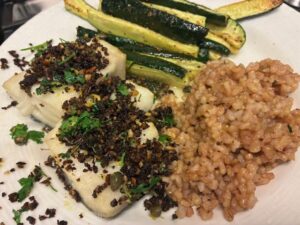
Speaking of filling and satisfying meals (and why not fun and easy, too) here’s what came together for me recently: Leftover brown rice fried in coconut oil, roasted zucchini spears and baked white fish. If you have time, a crumb topping adds a special touch.
Crumb Topping Low heat saute a little garlic and chile flakes; add the crumbs and cook for several minutes to toast. Remove from heat and add a little fish sauce (optional), lemon zest, parsley and salt and pepper to taste. Serve over cooked white fish. The crumbs are black because I ground them from a hearty whole grain Rúgbrauð bread.