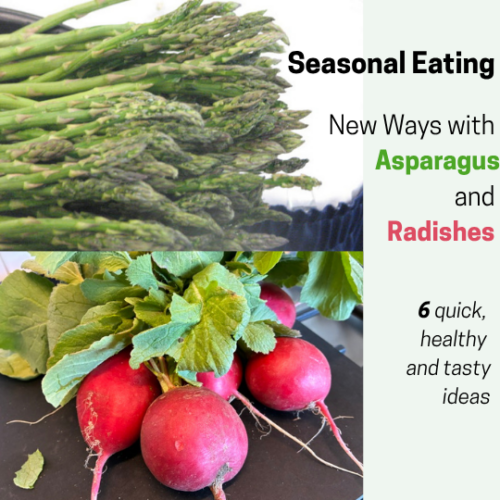
Spring can be a bit of a letdown when it comes to seasonal eating. With the warming weather we start having visions of juicy tomatoes, crisp cucumbers and vibrant eggplant. Go to the farmers market, however, and there’s only a sea of greens–lettuce, kale, chard and so on. Two bright spots are cheery red radishes and luscious asparagus (which I call the royalty of the vegetable kingdom!) Here are some uses for both for greater diet diversity.
How to Use Radishes–The Magic of Cooking
I surprised another shopper at the farmers market when I nabbed not just one but two bunches of radishes. She wondered what I was going to do with all of them, which was understandable. I had always walked right by radishes because I could never acquire a taste for their sharp taste. But I have since discovered a helpful secret: Cooking takes out most of the sharpness!
So here are four ways to put them to use (even the greens) which is especially nice because they are generally very reasonably priced! Plus you get more valuable nutritional diversity into the diet.
#1 Radish “Fries”
Cut radishes into matchsticks while heating olive oil over medium high heat. When oil is quite hot (but not smoking), add radish matchsticks carefully (to avoid splashing hot oil.) Sprinkle with salt (and pepper if desired). Flip as they brown until most sides are browned. Eat as a small side or use as a fun salad topping.
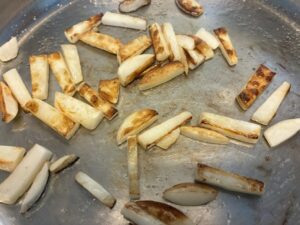
Pictured here are summer turnips cut into matchsticks, about 1/4″ square. Although they are a very mild turnip, they also taste great when fried.
#2 Radishes in Soups and Stews
Add large matchsticks (maybe 1/2″ square) to a soup or stew for something different. Generally I add them near the end of the cooking time so they don’t get mushy, about 5-10 minutes is enough.
#3 Roasting Radishes
Roast just like any other vegetable: Coat with olive oil, sprinkle with salt (and pepper if desired) and roast at 400(F) about 15 to 20 minutes until tender through. If radishes are large (like those in the photo at the top) halve before roasting so they cook through without burning on the outside.
#4 Use Those Radish Greens!
Look for radishes with their tops since they will increase the nutrition you get for your grocery dollars. Radish greens are surprisingly mild tasting–with none of the sharpness of the radish root. Chop the stems small and the leaves into roughly 1-2″ pieces. My favorite use: Sauteed and added to my breakfast scrambles. Or add to soups, stews and stir-fries.
How to Use Asparagus Ends: A Time-Saving Cooking Flow
I doubt anyone has trouble knowing what to do with asparagus. Just steam, stir-fry, roast or grill and you have a wonderful side dish. But what about the ends? Being too tough to eat with the usual cooking methods, they usually get tossed (or composted, hopefully.) But they are still full of flavor and free extra nutrition.
So when prepping stalks, first cut off the very toughest 1/2″ of the ends and compost. Then snap off the tough ~2″ section at the bottom and save in an airtight container. Now for a flow which can minimize dirty pans and set you up for a couple easy dishes:
The next time you make bone broth, strain the finished broth and return about 2-4 cups to the same cooking pot. Simmer the reserved ends with a little salt and pepper until very tender, which might take up to an hour. Cool and process in a blender until smooth (a Vita-Mix is especially good for making a velvety puree.) Pour into a jar with a lid and refrigerate or use immediately as below:
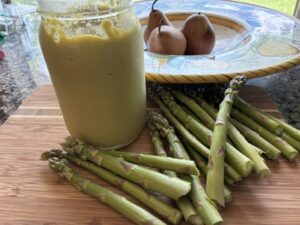
1. Creamy Asparagus-Ends Soup
With a flavorful broth, you may not need much more for a nice sipping soup, which can be especially good for tamping down hunger before a meal! However, asparagus puree is a very versatile base for lots of soup creativity. All sorts of additions can offer more substance or a nice flavor boost, e.g., a little butter, basil, Herbes de Provence, ginger, Italian Seasoning, brown rice, white beans, onion, mushrooms, chicken, or sausage.
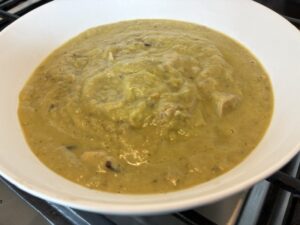
My puree became a quick lunch by adding leftover rice and chicken plus a little herb salad dressing for flavor.
#2 Grains Cooked in Asparagus Broth or Puree
While any grain can be cooked in asparagus broth or puree for a flavor and nutrition boost, I love using it to cook millet for a congee. A congee is a grain cooked in double the amount of liquid for a creamy porridge-like dish. For example, I used 4 to 4.5 cups of asparagus puree for 1 cup of millet. After enjoying the millet as a porridge, I transferred the leftovers into a baking dish and cooled so it congealed and could then be cut and fried as squares.
NOTES
- Store-Bought Broth Of course store bought broth can be used rather than homemade bone broth.
- Vegetarian Option Imagine(R) makes a very tasty Vegetable Broth that can be substituted.
- Instant Pot Option This kitchen appliance makes a bone broth—vegetable puree combo a little quicker and easier. I cook the bone broth for 1 hour and 20 minutes and then strain and use the same pot to cook the asparagus on the Steam setting for 8’ish minutes–in about 1 cup of broth (more for a thinner puree.)
 Finely chopped spring chives are a great addition to Creamy Asparagus-Ends Soup. And then enjoy the blossoms for a nice bouquet.