Quick Quiz
What time do you begin to cook?
A) When you race into the kitchen fully stressed about getting a meal on the table, fast?
B) When you start pulling food from the fridge, trying to figure out what to make with it?
C) When you hop out of the car and run in the grocery store hoping to find something to make?
D) When you stop in a calm spot and figure out what to make, a couple hours or even days before you ever set foot in the kitchen?
The best (and most helpful) answer? D !!
Is that a surprise?!! How can you ever start making a meal before you even get to the kitchen?!
It’s because the best way to start a meal is by making a meal time game plan at least an hour or two and, ideally, even a day or several days in advance.
Simone’s Story
Simone was a participant in a recent webinar who had some wise words about the think-ahead-and-plan habit, she said:
“I definitely know the point about planning, I know that if on the weekend we don’t plan what we’re having for the week, we might as well forget it. It’s the grocery store every day situation. It’s where we’re so tired by the end of the day that we’re like ‘what are we going to come up with?’ It’s very stressful which is the last thing you need at the end of the day. Planning makes a huge difference.”
The Power of a Plan
With a plan, there’s no need to stress and spin your wheels trying to figure out what to make when it’s late and you’re starving–and maybe others in your household are chomping at the bit, too. (Answer A) Instead, knowing exactly what to make, you hit the deck running and every precious minute is productive and efficient.
With a plan, you don’t need to dissemble your refrigerator in a desperate attempt to find something–anything–that will coalesce into a meal. (Answer B)
Finally, with a meal making plan, a shopping list practically makes itself. And with a list, grocery shopping is easily accomplished. No need to make “quick” trips to the store for missing ingredients. (Answer C)
But I Don’t Want To Do a Bunch of Planning Just to Make a Meal
We’ve been led to believe that meals should be totally easy and convenient–like a microwave pasta dish or takeout Chinese. So when we decide to put our health first and make our own, health-giving meals, it’s understandable that we don’t realize all the considerations that go into the critical first step: Deciding What to Make!
As one writer explained:
“Meal planning poses surprisingly complex challenges. Your brain is simultaneously calculating how many people are eating, the types of food they enjoy, ingredient preferences (and intolerances), your budget, the time available to cook and so on. No wonder so many weeknight end with mediocre [and often unhealthy] takeout.” (1)
And no wonder there’s a famous saying that “the hardest part about cooking is deciding what to cook!”
Since the decision is “surprisingly complex” (but not impossible!) you don’t want to figure out what to make when you’re racing in the kitchen at meal time, or dashing through the grocery store or desperately searching through the fridge. Instead, try to find a relatively calm moment, where you can pretty readily juggle and balance the various planning considerations and make some workable meal choices.
But Meal Planning Takes So Long, It’s So Boring–and Dumpy, Too!
As soon as I mention “Menu Planning,” doesn’t it just reek of old-fashioned tedium, like what you had to do in home ec! Or what you have to do once or twice a year for a big Thanksgiving or Christmas dinner.
But we’re not talking about the kind of planning you do for big holiday meals! Everyday meal plans don’t need to be as detailed, and the dishes don’t have to be anything fancy. What’s more, planning can be pretty quick and even fun!
An Everyday Plan
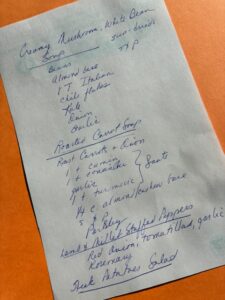
Take a look at my plan for the coming week that took me about 5 minutes.
Questions
How could my plan take only 5 minutes? It’s because I had a couple good meal ideas “in my pocket,” you could say.
Writer’s block is a big challenge when it comes to meal planning (and likely one of the biggest reasons we avoid it.) You sit down to make a plan, stare at a bunch of empty spaces and have no clue how to fill them. Of course you’ll want to run the other way! But here’s how I was able to quickly come up with a couple ideas:
- The Creamy Mushroom Soup and Roasted Carrot Soup both came from a single newsletter I got from the company where I buy the almond paste I use to make almond milk. (Both soups use the paste to thicken the soups.)
- The Stuffed Peppers are something I’ve been wanting to make so I could use up some of the amazing peppers I’ve been getting from my farm share.
- Steak, Potatoes and Green Salad was an easy choice given the delicious lettuce, tomatoes and potatoes in my farm share.
You probably come up with inspiration and ideas like this, too–just not when you sit down to plan a menu. So the trick is to make note of ideas right when they come up! Jot them down, put them in your phone, send them in an email, bookmark them–just don’t let them drop out of mind. When it’s time to plan, you’re halfway there.
How Do Four Plans = a Week’s Worth of Meals? First, I always make enough for leftovers. Secondly, I will often throw a super easy skillet into my meal lineup just to use up a number of things in the fridge. They are so easy that a plan isn’t really needed. (Here’s a video on this easy Skillet Method.)
What About Vegetables? After all my haranguing about vegetables, you might be surprised that many of the plans don’t include a vegetable side. For starters, vegetables are part of the soup, and pepper entrees.
But I value the advice to make 50% of the plate vegetables, so I will supplement with a vegetable side. I don’t map that out on my plans because I always have a good supply of produce in the fridge and am comfortable winging it with the veggies. But if it helps, plan out which you’ll use when so you are sure to buy them–and then use before they rot!
Meal Planning Resistance
There’s no question that the think-ahead-and-plan habit replaces a lot of the stress and aggravation of meal making with ease and success. So I’ve often wondered why more people don’t do it. Just consider the relief of racing into the kitchen knowing exactly what to make!
Over my 35 year in the field, however, I’ve noticed that there is more at work than the simple mechanics of jotting down a couple ideas. Very often, there is some sneaky meal planning resistance at work, keeping us stuck in last-minute decision making.
My resistance took the form of embarrassment. Here I was, a female liberated from the kitchen embracing a routine that my kitchen-bound mother used!
For others in my classes, resistance looked like:
- A certainty that there was no time to plan, even though planning always saves time, effort and stress;
- A belief that anything to do with meal making is not a worthwhile use of time;
- The thinking that meal planning is overwhelmingly difficult.
- Disbelief that meal planning could really make meal preparation easier, or even doable at all.
Along with writer’s block these resistance brain barriers are “silent killers.” Without you even knowing it, they crush your interest and motivation to even experiment with this magical practice.
But I KNOW that meal planning is the #1 best thing you can do to ensure that your good eating hopes and dreams get translated into real, health-giving meals on the table. Can you trust me on this?
Would You Like a Little Help Getting Started,
Beating Writers’ Block,
Blasting Past Resistance,
And Making the Meals of Your Dreams?
Please, please, please, join my online class:

- Jumpstart Past Writer’s Block: Get the Meal Planning Spark Chart with 18 helpful and interesting meal idea “sparks”
- Blast Past Resistance: Hear about the mind barriers that blocked previous participants and how they navigated past them to access the wonderful benefits of thinking and planning ahead.
- Plus: Lots of recipes, cooking demos, handouts and inspiration
50% off–just $47.50
(Contact me for discount)

What would you love to see on the table?
Meals that are wholesome? Fun?
Yummy? Something new and different?
Budget-friendly? Quick and easy?
Whatever your meal time hopes and dreams, plan for them and they will happen. Conversely, fail to plan and your hopes will fall by the wayside.
But Why All the Fuss About Meal Making? Why Bother?
The Quick Answer: Because the pathway to health runs through the kitchen.
More and more we are learning the damaging health consequences associated with factory-made, ultra-processed foods. Eating nature-made, real whole foods is the easy solution. But here’s the problem: Real, whole, health-giving foods have to be prepared, which takes time and effort. And who doesn’t feel tapped out on one or the other of those?
So if we don’t want to give up on our health (and I hope we don’t) then we have to find a way that meal making can work in our hyper-busy lives. Learning new skills, tools, habits and routines is the key.
Investing five to twenty minutes on planning is the #1 best tool that will turn healthy meal making into something that’s entirely manageable despite a busy schedule.
(1) “Does AI Satisfy,” Jane Black, Wall Street Journal, March 15-16, 2025