Has all the furor about seed oils taken you by surprise? The issue has been simmering for several years, but I was surprised when it exploded into a major controversy after recent changes to the food pyramid that cautioned against seed oil consumption.
I was happy to find an article by Dr. Mark Hyman that provided a clearer explanation of the issue and an easy solution. Following is my summary and comments, but for a deeper dive check out the full article.
First, What Is a “Seed Oil?”
As the name suggests, seed oils come from seeds, like canola, corn, cottonseed, soybean, sunflower, safflower, grapeseed, and rice bran.
Compare these oils with, e.g., olive and avocado oils. Both come from the fruit of the plant which can just be pressed or squeezed to extract its oil.
Seeds, on the other hand, don’t give up their oils so easily. To access their oils, manufacturers must resort to “heavy industrial processes involving high heat, high pressure, and chemical solvents.” (For a more detailed description of the process see The Truth About Industrial Seed Oils.)
Now, Are Seed Oils Bad For You?
“It depends on the context” is how I would summarize the answer.
The Helpful: Heart Health, Cost, Neutral Flavor Because they can help lower LDL cholesterol, a risk factor in heart disease, health experts have long advocated using seed oils as a heart-healthy alternative to saturated fats like butter and lard. While this could be a benefit, Dr. Hyman noted that non-seed oils like olive oil and avocado oil provide similar benefits without the potential downsides of seed oils.
Seed oils (a/k/a “vegetable oils”) also have some practical advantages which makes them attractive to consumers: They are inexpensive and have long shelf lives, a neutral flavor and a high smoke point which makes them good for high-heat frying. However, these practical advantages are also the source of seed oils’ problem, which is over-consumption.
The Not-So-Good: Over Consumption and the Omega 3 and 6 Imbalance Vegetable oils are used a lot in mass-produced processed foods exactly because they are relatively cheap, can be stored for long periods of time, have a neutral flavor that can be used with any type of food, and are great for high-heat frying.

This means we end up ingesting a lot of seed oils since on average over half our calories come from mass-produced processed foods. This, in turn, leads to an imbalance of Omega-3 fatty acids vs. Omega-6 fatty acids, which is where health problems arise.
The fact is, we need both 3s and 6s for good health, but they need to be balanced. Unfortunately, seed oils contain a high proportion of Omega-6 fatty acids and relatively little omega-3s. So when we eat a lot of foods containing seed oils, we end up with too many Omega 6s. (This is often compounded by low consumption of Omega-3 foods.)
We care about this imbalance because Omega-6 fats help produce molecules that can promote inflammation. Of course sometimes we need inflammation—such as to fight infections or repair injuries. But as we now know, too much or chronic inflammation has been linked to many health issues, like heart disease, diabetes, depression and cognitive decline, arthritis and obesity.
Fortunately, Omega-3 fats help produce compounds that reduce inflammation while supporting brain, heart, and overall cellular health. But they can’t reduce inflammation enough when they are outweighed by a high Omega-6 diet.
What’s more, the refining methods used to extract seed oils can oxidize the oils and produce byproducts that may also contribute to inflammation and other health risks.
So the Context In and of themselves, then, seed oils aren’t “bad.” Rather, problems arise in the “consumption context,” i.e., how much of them we eat and in what form. As importantly, it’s how many Omega-3 foods are we eating to balance the Omegs-6s in our diets.
Simple Seed Oil Solution #1: Replace Not-Foods with Real Whole Foods
As always and not surprisingly, the solution lies in eating real, whole foods and only real, whole foods since they don’t contain extracted seed oils! Meanwhile cut back (and even eliminate) the ultra-processed not-foods that are the primary source of Omega-6 over-consumption–a solution that benefits your health in many other ways, too
For myself, I keep a bottle of safflower oil handy when I want a neutrally flavored oil (e.g. for baked goods and some ethnic foods) or for high-heat frying and stir-frying (because olive oil isn’t good for high-heat cooking.) Importantly, however, I use this oil only rarely, maybe every other week, in very small amounts of about one tablespoon per dish, and only as part of a real, whole food meal.
The Simple Solution #2: Bump Up Omega-3 Foods
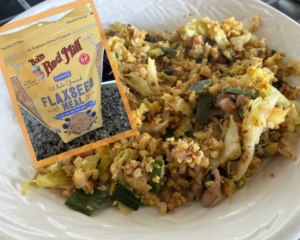
Writing this article has inspired me to work more Omega-3s into my diet. My current targets: flax seeds, chia seeds and walnuts. Although I don’t have trouble weaving walnuts into my dishes, flax and chia require a little more thought. Interestingly, I did just buy a bag of flax seed meal and was surprised by its high Omega-3 content. So after drafting this article, I sprinkled a spoonful into my cabbage stir-fry. Added a little wholesome nuttiness–plus Omega-3s